

Battery sizing is where a lot of solar quotes go wrong. Too small and you still buy expensive evening electricity from the grid. Too big and you have paid for storage that never fills. The right size for a home in Northern Ireland depends on three numbers: how much electricity you use, how much of it you use after dark, and how much your panels will generate. Here is how we size solar battery storage for NI homes, and how to estimate your own.
Start with how much power you shift to the evening
Solar panels generate during the day. Most households use the bulk of their electricity in the morning and evening. A battery bridges that gap by storing daytime surplus and releasing it after sunset. So the size you need is roughly the amount of electricity you use between sunset and sunrise, on a typical day, that your panels could have covered.
For a quick estimate, take your annual electricity use in kWh from a recent bill and divide by 365 to get a daily figure. For most working households around 60-70% of that is used in the evening and overnight. A home using 3,650 kWh a year uses about 10 kWh a day, of which 6-7 kWh is evening and overnight use. In summer the panels will easily fill a battery that size; in winter they will not, and the battery simply charges less.
Typical battery sizes for NI homes
These are the pairings we install most often, and they line up with the usage bands in our solar panel price guide:
- 5kWh battery with 5kW of solar for homes using 2,000-4,000 kWh a year. Typical for a two or three-bedroom house with gas or oil heating.
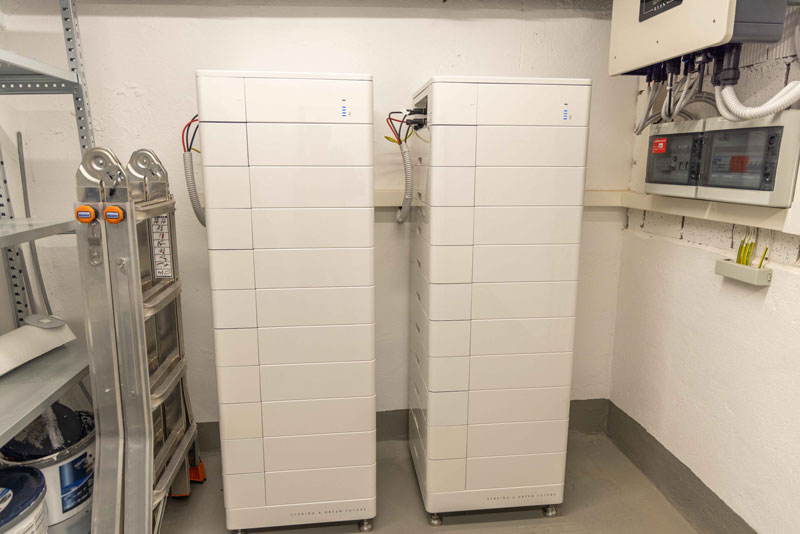
- 10.24kWh battery with 7.2kW of solar for homes using around 6,000 kWh a year. Families of four, someone working from home, or an electric car charged a couple of times a week.
- 15.36kWh battery with 9kW of solar for homes using around 8,000 kWh a year, with an EV, a heat pump or a need for backup power.
Those sizes are not rules. They are the combinations where the battery fills most days from spring to autumn and empties most evenings, which is what makes storage pay. Our solar panel system pages walk through what each array size generates in Northern Ireland.
Usable capacity versus the number on the box
A battery’s headline capacity is not quite what you get. Most lithium batteries keep a small reserve to protect the cells, so a 10kWh unit might deliver around 9kWh of usable storage. Round-trip losses, the energy lost charging and discharging, take another few percent. When you compare quotes, ask for the usable figure, not the nominal one, and check that the battery can discharge fast enough to run your evening peak: an oven, a kettle and a tumble dryer at once draw far more than a battery with a low power rating can supply, and the shortfall comes from the grid.
Why bigger is not always better
Every kilowatt-hour of storage you pay for needs to be filled and emptied regularly to earn its keep. A battery that is only half used most days is a battery that will never pay back. In Northern Ireland the maths is unusually clear: import prices are 27-30p per kWh while export rates from suppliers such as Power NI are well below that, so storing a unit for your own use is worth two to three times more than exporting it. That favours a battery, but one sized to the evening load, not the biggest one in the brochure. We covered the trade-offs in detail in oversizing solar batteries: why bigger is not always better.
When to size up
- An electric car. Charging overnight from a battery that filled during the day can be the single biggest saving in the house. Add roughly 5kWh of capacity for a car charged a few times a week.
- A heat pump. Heat pumps run most in the evening and in winter, when generation is lowest. A larger battery lets you charge from a cheap overnight tariff on dull days as well as from solar.
- Backup power. If you want the lights and the fridge to stay on during an outage, you need both spare capacity and a battery system that supports it. Not all do; EcoFlow systems we fit can.
- Growing use. Modular systems let you add capacity later. If you are planning an EV or a heat pump in the next couple of years, choose a battery you can expand rather than one you will replace.
When a smaller battery, or none, is the right call
If someone is home all day, running the washing machine, the dishwasher and the hot water from the panels as they generate, a lot of the solar is used directly and a small battery, or none at all, can be the better investment. The same goes for very low users. We say this on every survey because it is true: a battery is the right call for most working households, but not for all of them, and anyone who insists you need one before asking how you use electricity is selling, not sizing.
How we size it for you
During the free survey we look at your actual consumption, ideally from a smart meter or a year of bills, the roof and its orientation, and what is coming down the line, whether that is a car, a heat pump or a conservatory. From that we model generation month by month and pick the battery that fills and empties most days of the year. Then you get a fixed, itemised quote with the battery listed separately so you can see exactly what it costs and what it saves. Get a quote in two minutes or call 02895 908 588.