
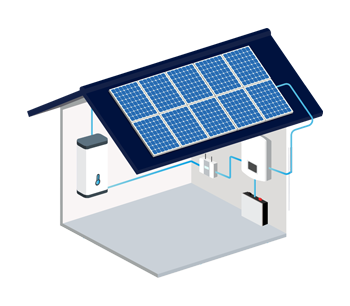
The short answer: for most homes here, yes. Solar panels without a battery leave a lot of value on the table in Northern Ireland, because our generation and our usage happen at different times of day. A correctly sized battery closes that gap. Here is the honest case for and against, from an MCS certified installer fitting battery storage and solar panels NI wide.
Why Northern Ireland’s Daylight Pattern Suits Batteries
An NI array typically generates around 850 to 950 kWh per year for every kWp installed, and the shape of that generation is the point. In summer, panels produce from early morning to late evening, with the bulk arriving through the middle of the day. In winter, generation is shorter and lower. Household usage does the opposite: it peaks at breakfast and again in the evening, exactly when the panels are winding down.
People sometimes assume our climate undermines the case, but it is the opposite. Panels generate from daylight, not just direct sunshine, and even on an overcast Ulster afternoon a decent array is producing. What our weather does mean is that generation arrives unevenly, with bright spells and dull spells across the same week, and a battery smooths exactly that kind of pattern.
Without storage, much of what you generate on a bright day is exported to the grid while you are out, and you buy electricity back at the full unit rate that evening. A battery simply moves your own midday electricity into the hours you actually live in.
The Evening Shift: What Actually Changes On Your Bill
With a battery, a typical day looks like this. Overnight, the house draws very little. Through the morning and midday, the panels run the house and charge the battery. From late afternoon, when cooking, washing, heating controls and screens all come on together, the house runs on the battery instead of the grid, often deep into the night in summer. The result is that most of the electricity your roof generates gets used inside your own four walls rather than sold cheaply and bought back dear.
In winter, some households add a second trick: charging the battery from a low rate overnight tariff and running the morning on stored cheap electricity. Sized and set up properly, the battery earns its keep even in the darkest weeks of the year. Depending on the setup, some systems can also keep essential circuits running during a power cut, which is worth raising at survey stage if it matters to you.
What About Exporting? The Power NI Microgeneration Tariff
You may have read about the Smart Export Guarantee. That scheme applies in Great Britain and does not operate in Northern Ireland. Here, the main export route is Power NI’s Microgeneration Tariff, which pays 9.64p per kWh for the 2025/26 year, with the rate reviewed each October.
Export income is welcome, but do the comparison. A unit you export earns 9.64p, while a unit you use yourself avoids buying that same unit at your supplier’s full rate, which is far higher. That gap is the entire argument for storage. Export what is genuinely spare, and let a battery make sure spare is the right word.
Sizing: Why 5kWh To 20kWh Covers Almost Everyone
Battery capacity should follow your usage, not your budget’s upper limit. In broad strokes:
- Around 5kWh suits a smaller household with modest evening usage.
- 10kWh is the sweet spot for a typical NI family home, covering the evening and overnight comfortably.
- 15 to 20kWh earns its place where usage is genuinely high: larger families, home workers, a heat pump, or an EV charging from solar.
Bigger is not automatically better. An oversized battery spends the winter half empty and cycles too shallowly to justify what you paid for it. We size from your actual bills and usage pattern, and we will happily talk a customer down to a smaller unit when the numbers say so. Our battery storage page explains the options we install and how retrofits work for homes that already have panels.
What Does A Battery Cost?
Battery pricing depends on capacity, whether it goes in alongside a new solar system or is retrofitted later, and the electrical work involved. We keep figures out of blog posts because they date quickly; our solar panel cost guide has the current breakdown. Two things help the arithmetic: 0% VAT applies to installations until 31 March 2027, and fitting the battery at the same time as the panels means you pay for scaffolding and an electrician’s visit once, not twice.
The Honest Verdict
Battery storage is worth it for the large majority of NI homes we survey: anyone out during the day, anyone with meaningful evening usage, anyone with an EV or heat pump on the horizon. The marginal cases are real too. A home with someone in all day, running appliances at noon and using little in the evening, already self consumes well and may see a slower return. That is a survey conversation, not a guess. With Northern Ireland targeting 80% renewable electricity by 2030 under the Climate Change Act 2022, the grid is only heading one way, and homes that can store their own generation are ahead of it.
Local to Bangor?
Bangor has one of the strongest commuter populations in Northern Ireland, and commuter households are exactly where batteries shine: the house is empty during peak generation and busy all evening. Our solar panel installers in Bangor page covers how we design solar and storage across North Down.
Local to Newry?
From the city itself to the surrounding rural homes with generous roof space, Newry households often run larger arrays, where a battery captures a serious midday surplus that would otherwise be exported for pennies. See our solar panel installation in Newry page for how we handle design, installation and export registration locally.