
Payback is the question behind every other question about solar panels in Northern Ireland. Savings are nice, but what people really want to know is how many years it takes for the system to cover its own cost and start putting money in your pocket. The honest answer for a typical NI home is somewhere between six and eleven years, and the gap between those two numbers is mostly down to how well the system is sized to the way you use electricity. Here is how to work it out for your own house.
The simple payback sum
Payback in years is the installed price divided by what the system saves you each year. If a system costs £7,000 and saves £900 a year on your bills, it pays for itself in just under eight years. Everything after that is free electricity for the rest of the system’s life, and modern panels carry 25-year product warranties and 30-year performance warranties, so that is a long tail.
The sum is simple. The two numbers going into it are not, which is why two neighbours with the same roof can see very different paybacks.
Typical payback periods in Northern Ireland
Using the typical installed prices and savings from our guide to solar panel prices in Northern Ireland, at current NI electricity rates of around 27-30p per kWh:
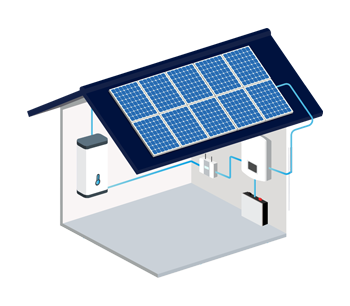
- 5kW solar with a 5kWh battery, suited to a home using 2,000-4,000 kWh a year: typically £6,000-£7,000 installed, saving around £600-£1,000 a year. Payback of roughly 7 to 11 years.
- 7.2kW solar with a 10.24kWh battery, suited to a home using around 6,000 kWh: typically £8,000-£10,000, saving around £1,400 a year. Payback of roughly 6 to 7 years.
- 9kW solar with a 15.36kWh battery, suited to a home using around 8,000 kWh or with an EV: typically £10,000-£12,000, saving around £1,800 a year. Payback of roughly 5.5 to 7 years.
Two things stand out. First, bigger systems pay back faster, because the fixed costs of an install (scaffolding, labour, electrical work, certification) do not scale with panel count. Second, the payback is only that quick when the system matches the household. A 9kW array on a 3,000 kWh home exports most of what it makes at a fraction of the import price, and the payback stretches out.
These are typical ranges, not quotes. Every roof is surveyed and priced individually, and the numbers above assume electricity prices stay flat, which they have not done in any recent five-year period.
What shortens the payback
Using your own power instead of exporting it
Every unit you use yourself is worth the full import price. Every unit you export is worth your supplier’s export rate, which in Northern Ireland is well below the import price. That is why self-consumption matters more here than the headline export tariff. A home that is empty all day and busy in the evening uses only around half of its generation without a battery, and 70-80% with one.
Higher electricity prices
NI electricity prices run several pence per kWh above the GB average. That sounds like bad news, and for your bill it is, but for payback it is good news: every price rise makes each kilowatt your roof produces more valuable and shortens the period.
0% VAT
Domestic solar panels, batteries and installation are zero-rated for VAT in Northern Ireland until at least March 2027. On a £7,000 system that is £1,400 you are not paying compared with the standard rate, which takes roughly a year and a half off a typical payback on its own.
Export payments
The GB Smart Export Guarantee does not operate in Northern Ireland, but you can still be paid for surplus units through your electricity supplier’s microgeneration tariff, such as Power NI’s. The rates are modest, so treat export income as a bonus that trims a few months off, not the foundation of the case. You need an MCS-certified install and an NIE Networks registration to qualify, both of which we handle.
What lengthens it
- Oversizing. Paying for capacity you cannot use. We size from your annual kWh, not from how many panels fit on the roof.
- Shading. A chimney or tree across one string can drag the whole array down unless optimisers or micro-inverters are specified. That costs a little more up front but protects the generation.
- Orientation. An east or west roof generates around 15-20% less than a south-facing one. Still worthwhile, as we explain in our post on whether panels need to face south, but it adds a year or so.
- A battery that is too big. Storage is usually worth it for working households, but a 15kWh battery on a home that only shifts 4kWh into the evening is money that will never come back. More on this in is battery storage worth it in Northern Ireland.
A worked example from a typical NI home
Take a three-bedroom semi in Lisburn using 3,800 kWh a year, with a south-west roof and nobody home between nine and five. A 5kW system with a 5kWh battery suits it. Installed for around £6,500 with 0% VAT, it generates roughly 4,200 kWh a year in Northern Ireland conditions. With the battery the household uses about three quarters of that itself, saving around £900 a year at today’s rates, and exports the rest for a small credit. Payback lands at about seven years. Over the 25-year panel warranty that is roughly 18 years of near-free electricity after the system has paid for itself, before any price rises are counted.
How to find out your own number
You need two things: your annual electricity use in kWh, which is on any recent bill, and a fixed price for your roof. We survey every home free of charge, model the output for your actual roof and orientation, and quote a fixed, fully itemised price with no follow-up sales calls. From that you can do the payback sum in thirty seconds. Get a quote in two minutes or call 02895 908 588.